15 Cold Call Opening Lines That Actually Book Meetings

The best cold call openers give the prospect control. Something like "I know I'm calling out of the blue, do you have 30 seconds so I can tell you why?" works because it lowers defenses instead of triggering them, and Brandon Mulrenin's data shows some of these lines reach 88.6%. Three things matter: keep your opener under 15 seconds, state a reason for calling that's about the prospect (this alone boosts success 2.1x per Gong), and stay away from pattern-matching lines like "How are you today?" or "Is this a bad time?" Below are 15 tested openers across four categories, plus the data on why they work.
Your opener does most of the work on a cold call. Get it right and you earn 30 seconds to make your case. Get it wrong and you hear a click.
Gong's analysis of over 90,000 cold calls found the average rep connects with just 5.4% of prospects, while top reps connect with 13.3%, more than double the rate. A lot of that gap comes down to the first 10 seconds.
Most openers fail because they sound like every other sales call the prospect got that day. The ones below work because they break the pattern.
After cold calling for 20 years, I found the best opening line
What Makes a Good Cold Call Opener
First, know what separates a good opener from a bad one. Research from Nielsen Norman Group shows you have about 10 seconds to grab a prospect's attention. After that, your odds of converting drop off fast.
Good openers:
- Sound human, not scripted
- Give the prospect a reason to listen
- Create curiosity or relevance
- Are under 15 seconds
- State the reason for calling (this alone increases success rates by 2.1x according to Gong)
Bad openers:
- Start with "How are you today?" (though Gong found "How have you been?" actually works well at 6.6x success rate)
- Launch into a pitch immediately
- Use fake familiarity ("We haven't met but...")
- Are too long before getting to the point
- Open with "Did I catch you at a bad time?" (makes you 40% less likely to book a meeting)
Opening with "Happy Monday!" or similar day-of-the-week greetings tested very poorly in multiple studies. As one sales expert put it, it's "the most childish approach to cold calling." People hate it.
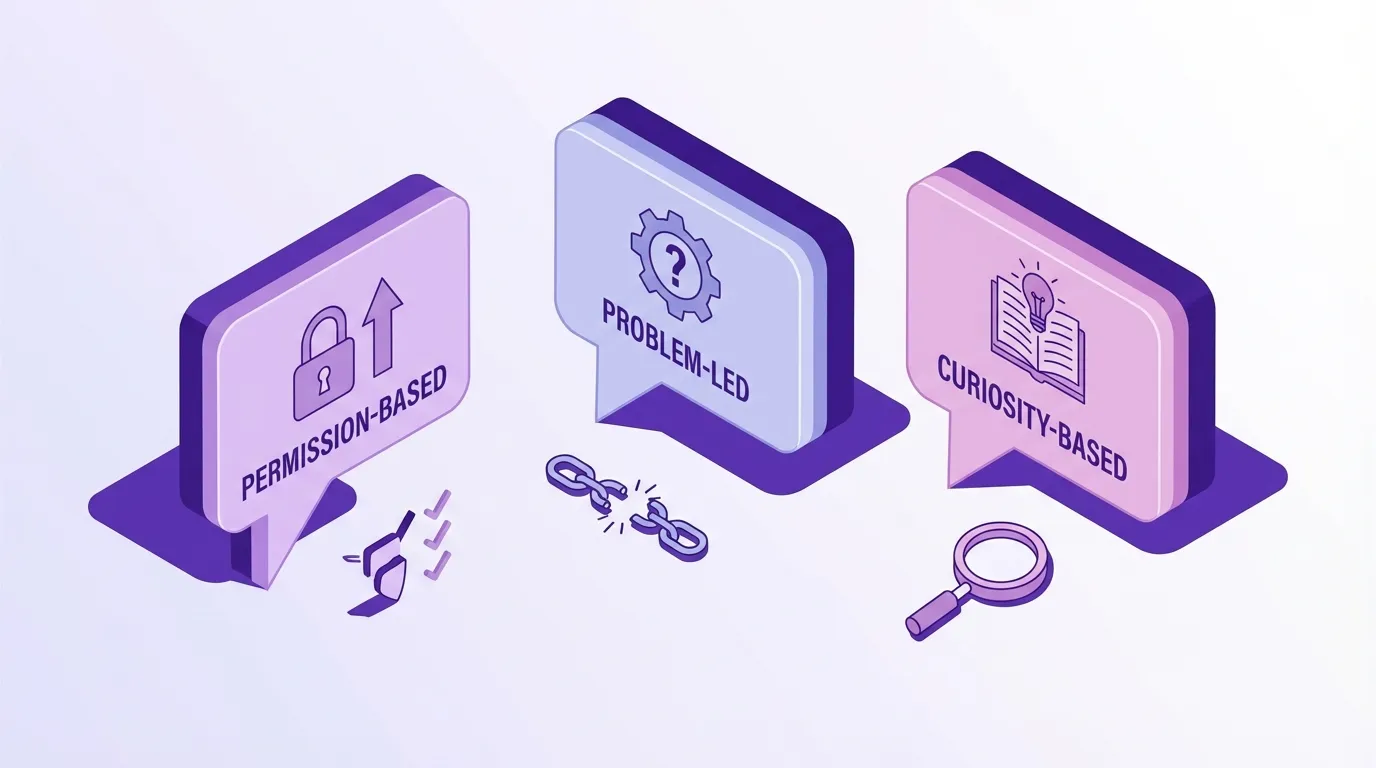
Permission-Based Openers
Hand the prospect control and, counterintuitively, they're more likely to keep listening. Brandon Mulrenin's research on 1,000 cold calls found that permission-based openers can hit success rates as high as 88.6%.
1. The direct approach "Hi [Name], this is [Your Name] from [Company]. I know I'm calling out of the blue. Do you have 30 seconds so I can tell you why, and you can decide if it's worth continuing?"
2. The transparent cold call "Hi [Name], this is [Your Name] from [Company]. For full transparency, this is a cold call. I appreciate that I've called completely out of the blue. Is now a bad time for a two-minute chat?"
This one from Cognism's research sounds risky, but it gets great results and the occasional laugh. The honesty disarms prospects who are braced to be pitched the second they pick up.
3. The referral-style "Hi [Name], [Mutual Connection] suggested I reach out. They mentioned you're [relevant situation]. Mind if I share why?"
4. The relevant trigger "Hi [Name], I noticed [Company] just [trigger event]. We help companies in that situation with [specific outcome]. Got a minute?"
Gong data shows that calls using "we" instead of "I" increase success rates by 35%. Frame your conversation around partnership, not pitching.
Problem-Led Openers
These land because they go straight to something the prospect actually cares about. Lead with a problem you know they're facing and you've earned their attention.
5. The pain point "Hi [Name], most [their role] I talk to tell me [common problem]. Is that something you deal with too?"
6. The competitor insight "Hi [Name], we work with companies like [similar company] who were struggling with [specific problem]. Curious if that resonates?"
7. The industry trend "Hi [Name], [industry trend] is forcing a lot of [their role] to rethink [process]. I have an idea that might help. Worth 30 seconds?"
8. The specific metric "Hi [Name], I was looking at [their company] and noticed [observable metric or trend]. We've helped similar companies improve that by [percentage]. Would that be worth a quick chat?"
Curiosity-Based Openers
These make the prospect want to hear more. You open an information gap, and they have to keep listening to close it.
9. The specific result "Hi [Name], we helped [similar company] increase [metric] by [amount]. I have a quick idea for how [their company] could do the same."
10. The unexpected angle "Hi [Name], this might be a weird question, but what's your biggest frustration with [process they use daily]?"
11. The contrarian take "Hi [Name], most [their role] are approaching [challenge] wrong. Mind if I share what we're seeing from the companies getting it right?"
12. The pattern interrupt "Hi [Name], you're going to hate me. I'm calling about [topic]. Want to hang up or give me 30 seconds to tell you why?"
This opener from Brandon Mulrenin's research hit an 88.6% success rate by leading with humor and handing control straight to the prospect.
Advanced Openers for Experienced Reps
Once the basics are second nature, try these:
13. The insight opener "Hi [Name], I was researching [their company] and noticed [specific insight from their LinkedIn, press release, or company news]. That made me think you might be dealing with [related challenge]. Am I off base?"
14. The mutual connection pattern "Hi [Name], I've been working with [their competitor or peer company] on [specific initiative]. They mentioned your name as someone who might be thinking about the same thing."
15. The value-first opener "Hi [Name], I found something that could save [their company] [specific amount/time] on [specific process]. It'll take 30 seconds to explain. Worth it?"
The Data Behind Effective Openers
According to Gong's research:
- Successful cold calls average 5:50 minutes vs. 3:14 for unsuccessful calls
- Top reps talk 55% of the time during successful cold calls
- Stating your reason for calling increases success rates by 2.1x
- Cold calling nearly doubles your email reply rate (3.44% vs 1.81%) even if you don't connect live
The typical cold-calling success rate in 2025 is around 2.3%, according to recent industry data. Reps who nail their openers and stick to frameworks that work beat that number consistently.
How to Find Your Best Opener
No single opener works for everyone. Test three to five over a week, track which ones actually start conversations, and double down on the winners.
A simple way to run the test:
- Pick 3-5 openers from this list
- Use each opener for 20+ calls (minimum sample size)
- Track your connect-to-conversation rate for each
- Double down on winners, drop the losers
- Iterate. Small tweaks can make big differences
Use a cold call simulator to try new openers before you burn them on real prospects. You can run the same opener 10 times in an hour and tighten your delivery and tone each pass. That's faster feedback than live calls will ever give you.
Common Mistakes to Avoid
Even great openers fall flat when you deliver them badly. Watch for these:
- Reading word-for-word. Your opener should sound conversational, not recited.
- Speaking too fast. Nerves make reps rush. Slow down.
- Ignoring tone. A great script with zero energy behind it dies on contact.
- Not adapting. If a prospect sounds rushed, adjust.
- Giving up after one objection. The conversation starts when they push back.
For more on handling those objections, check out our guide on how to handle sales objections.
Key Takeaways
- Keep your opener under 15 seconds
- Give the prospect a reason to listen that's about them
- Permission-based openers reduce pressure and can hit 88%+ success rates
- State your reason for calling. It increases success rates by 2.1x
- Test multiple openers and track what books meetings
- Practice delivery, not just words. Tone and pace matter as much as the script
Frequently Asked Questions
What is the best cold call opening line?
The highest-performing openers are permission-based lines that give the prospect control, such as "Hi [Name], this is [Your Name] from [Company]. I know I'm calling out of the blue. Do you have 30 seconds so I can tell you why, and you can decide if it's worth continuing?" Brandon Mulrenin's analysis of 1,000 cold calls found permission-based openers reach success rates as high as 88.6%. There's no single best line for everyone, so test 3-5 openers over a week and keep the ones that book meetings.
How long should a cold call opener be?
Keep your opener under 15 seconds, and ideally around 10. Research from Nielsen Norman Group shows you have roughly 10 seconds to grab attention before your odds of converting fall sharply. State your name, your company, and a relevant reason for calling, then hand control back to the prospect with a permission question.
How do you start a cold call without sounding scripted?
Lead with a reason for the call that's about the prospect, not your product, and deliver it conversationally rather than reading word-for-word. Slow down, vary your tone, and use a permission-based or curiosity-based opener that invites a response. Saying the same opener out loud 10+ times (for example with a cold call simulator) is what makes a script sound natural instead of recited.
Should you ask "How are you today?" on a cold call?
Skip "How are you today?". It signals a sales call and puts prospects on guard. Oddly enough, Gong found that "How have you been?" performs well, with a 6.6x higher success rate, because it implies a prior relationship. Also avoid "Did I catch you at a bad time?", which makes you 40% less likely to book a meeting, and day-of-week greetings like "Happy Monday!" which test very poorly.
What makes a cold call opener effective?
Effective openers sound human rather than scripted, give the prospect a specific reason to keep listening, create curiosity or relevance, stay under 15 seconds, and clearly state the reason for calling, which alone increases success rates by 2.1x according to Gong. Using "we" instead of "I" lifts success rates by about 35%.
How do I know which opener works best for me?
Test it with data. Pick 3-5 openers, use each for at least 20 calls to get a valid sample, track your connect-to-conversation rate for each, then double down on the winners and drop the rest. Small tweaks to wording, tone, and pace can move your numbers significantly, so keep iterating.
More cold calling resources:
- The Ultimate Cold Call Script Guide: 12 complete scripts
- 21 Cold Calling Tips from Top Performers
- 25 Common Sales Objections: how to handle every pushback
Knowing a great opener and delivering it naturally are two different things, and only practice closes that gap. Learn more about how to cold call effectively or start reps with an AI cold call simulator.
Related Articles

The Ultimate Cold Call Script: 12 Templates That Actually Book Meetings
Cold call script templates for every scenario. Get past gatekeepers, beat objections, and book more meetings, with free downloadable templates.
How to Practice Cold Calling: 7 Proven Ways to Get Better (Solo or on a Team)
The best ways to practice cold calling: with a partner, by recording yourself, or with an AI roleplay tool. A practical guide to a weekly practice routine that actually improves your dials.

Objection Handling: The Complete Framework for Sales Reps
A complete objection handling framework for B2B sales: the mindset, a repeatable 4-step method, and the most common objections with scripts.